I ended last week’s blog post right smack dab in the middle of the story of Ruth. Naomi and Ruth had just started their journey back to Naomi’s hometown of Bethlehem. Naomi was bitter as can be with God for her adversity. Ruth was just as devastated, yet she was desperately longing for a new beginning. She had heard of this God of Israel- of His power and zealous love of His people. She had heard Naomi talk about Him and could see her now bitterness towards Him. Ruth was intrigued. Her many gods in Moab were not relational at all, and yet Naomi spoke of this God so relationally. She might be mad at God, but it was as if she were angry at a family member. She wanted to know Him, too. This is where we pick back up the story.
In Ruth 1:22 it says, “So Naomi returned, and Ruth the Moabite her daughter-in-law [went] with her, who returned from the country of Moab. And they came to Bethlehem at the beginning of barley harvest.” Barley is harvested in the spring, so we know that the ladies came to Bethlehem right at springtime. From winter in Moab to Spring in Bethlehem. The leaves were starting to pop out on the trees, flowers were blooming, and the rain and gloom of winter was finally giving way to the sunny and mild days of spring. There had been a famine, but now the first grain of harvest for the year was ready to be brought in.

The women start to get settled into their new routine, and I can imagine Naomi giving Ruth a detailed tour of the town the first few days. I picture them walking side-by-side around the dusty streets and Naomi introducing her daughter-in-law proudly to her friends. Her answering Ruth’s eager questions about their God and their customs, and who everyone was and how they’re related. I bet they stood on the highest hill and looked out over the fields ready to be harvested, and Naomi explained who owned each plot of land and maybe what it was like growing up there or meeting her husband for the first time. And can you imagine the delight they must have felt to actually see fields full of barley again?
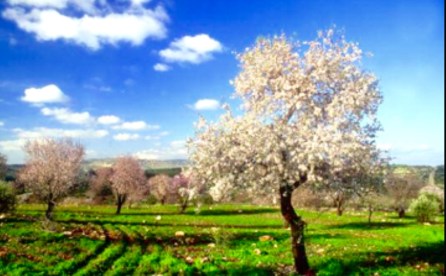
Ruth could have chosen to let bitterness take root in her heart like Naomi. After all, she too was a widow, was unable to bear children, lived through a famine, and gave up her homeland and culture. Instead of giving up though, she responds to the circumstances around her quite differently. In chapter 2:2, it says that Ruth asked Naomi, “Let me go to the field and glean among the ears of grain…” Then verse 3 tells us that she went out and got to work gathering the leftover grain from the reapers all day long. This was very labor intensive work! The Jewish law of that time required that when a field was harvested, anything that fell from the sheaves should be deliberately left behind so that the poor, homeless, orphans, and widows willing to work to gather food would have something to find. (Deut. 24:19-20). Ruth saw an opportunity to get food for her and Naomi, and although it was bound to be humbling and very difficult work, she did it anyway. It also could have been dangerous work for her to be working alone in a field with men that could easily have taken advantage of her weakness.
I found it so fascinating to learn that barley and wheat were the most important food crop of Ancient Israel because grains made up over 50% of the population’s caloric intake for the year. The grains would be planted in the fall and then mature throughout the damp and cold months of winter. Barley is particularly tolerant of harsh conditions and capable of maturing quicker than other grains. This makes for an earlier harvest and a more likely guarantee of some sort of food crop despite a tough year. I don’t think it’s an accident that the Bible tells us not only the season when Ruth came to Bethlehem, but that it also mentions the specific type of plant getting harvested. Perhaps it is a subtle example of what we see happening in Ruth’s life. Instead of becoming bitter or giving up despite such challenging circumstances, we see Ruth grow and mature in the midst of adversity and probably because of it. Isn’t that remarkable?

As the second chapter of Ruth starts, we are also introduced to a man named Boaz. He is a relative of Elimelech (Naomi’s deceased husband), and most likely was his cousin or nephew (but that is mostly just a guess). The Bible tells us that he was a worthy man which means that he was very respected, trustworthy, financially wise, and Godly. Later we find out that the very field Ruth is gleaning in belongs to Boaz. It’s interesting to point out that despite the famine, Boaz seemed to not only survive but to thrive. And unlike his relative Elimelech, he did not run away to a foreign land, but he stayed and grew in his faith and worked hard to use the land God had provided for him.
I am so excited to talk about this next part of the story that I literally feel like I cannot type fast enough! Ruth 3:3-5, “So she set out and went and gleaned in the field after the reapers, and she happened to come to the part of the field belonging to Boaz…And behold, Boaz came [just happened to come] from Bethlehem. And he said to the reapers, ‘The LORD be with you!’ And they answered, ‘The Lord bless you!’ Then Boaz said to his young man who was in charge of the reapers, ‘Whose young woman is this?'”
The servant responds to Boaz by explaining that she is Naomi’s daughter-in-law from Moab and that she asked politely if she could glean in the field. The man also explained that she had been working hard from early morning and throughout the day. Boaz saw this skinny and determined young woman humbly picking up leftover pieces of grain in his field to try to gather enough to make bread for herself and her mother-in-law, and he was moved with compassion for her and wanted to protect her. He went over to her and told her not to glean in anyone else’s field but his, and that he had told the men not to touch her or bother her. He told her that she should also feel free to drink from the well when she was thirsty. Ruth’s jaw must have dropped!
She asked him, “Why have I found favor in your eyes, that you should take notice of me, since I am a foreigner?” She knew that she was not only a poor widow in this land but that she was a foreign poor widow. She was technically the lowest of lows in their community. Yet Boaz saw her and showed her grace, protection, and favor.
Boaz answered her, “All that you have done for your mother-in-law since the death of your husband has been fully told to me, and how you left your father and mother and your native land and came to a people that you did not know before…The LORD repay you for what you have done, and a full reward be given to you by the Lord, the God of Israel, under whose wings you have come to take refuge!”
Boaz blessed Ruth for the character she had shown but also for her work ethic. Clearly her young faith in God was evident not only in her care for Naomi, but in the way she respected the law and customs of the Israelite people. Ruth really was serious when she told Naomi, “Your people will be my people and your God my God.” Just as she was diligently picking up seed by seed of dropped barley, she was also diligently studying the customs and ways of God’s people and learning more about Him. Little by little she was growing in her faith, and little by little God was transforming her into the woman He had made her to be.
Our culture likes to call moments like these:blind luck or random chance. We’ve all read books or seen movies where two people just happen to bump into each other while doing the most mundane of tasks and then they magically fall head-over-heels in love and live happily ever after. Well, call me a cynic, but I don’t believe in dumb or blind or really any kind of luck; and I certainly don’t believe in random chance. But I do believe in the sovereignty of God. I believe in His power and in His ability to bring about His will even when it seems impossible. I believe that our “just happened to’s” are His divine setups. I believe that His perfect timing is sometimes so happenstance to us, that we think it is a random coincidence. But stories of redemption for God’s people are not random to God. He has the ending in mind all along.
Then Boaz continued to show Ruth favor when it was time to eat. In Ruth 2:14-15, Boaz invited her to come sit at his table and eat a meal with him and his servants. The Bible says that she ate until she was completely full. How long do you think it had been since she had been completely satisfied and full after a meal? Between the famine and most likely the poverty that could come with being a widow, she probably hadn’t had a good meal in quite some time. But Boaz doesn’t stop there. After they were all done eating and it was time to continue working, he specifically asked his reapers to purposely leave her extra bundles of grain for her to take. He had already shown her great favor, but this was favor in excess. By the time Ruth went home to Naomi, she had around 6 gallons of flour. (That was the best way for my brain to understand the amount of barley she brought home when it says she brought home about an ephah of barley. This is the same as 22 liters, which is 5.8 gallons. #nerd)
It was not an accident that Ruth came to Bethlehem. It also was not an accident that Boaz had compassion on a woman like Ruth. In fact, God had been preparing Boaz’s heart for this moment his whole life. Do you happen to know who Boaz’s mom was? Her name was Rahab. She was a prostitute in the land of Jordan that helped protect two of the Israelite spies as they came to see the land God had promised them. Because of her knowledge of who God was and her therefore willingness to protect the two men despite the risk to herself, God protected her and her family even when the wall she lived in literally crumbled into dust all around her. God gave her a new reputation and a new family with His special people. It’s no wonder that Boaz was moved with compassion for Ruth. His momma raised him right. He knew personally that God can use the most unexpected people to somehow accomplish something extraordinary.
So as I get toward the end of this blog post, I want to try to bring this story to a more personal level. Over and over again in the Bible we are given examples of God’s faithfulness to provide, to protect, and to restore. You see, the story of Ruth could have ended right here, but it doesn’t. God still has more planned for these people, and He also has plans for you.
Who do you relate most to as you read this story with me? Is it Naomi who is paralyzed by bitterness and grief? She is weighed down by her adversity. Living with regrets from her past but also with hopelessness for the future. If that’s the case, I want to encourage you to do what Naomi did. Return home. Home to the beginning of your faith. Remind yourself of God’s character and of times you’ve seen Him work in the past. Review your favorite verses or Bible stories.Tell God about your frustration and your hurt. Then, don’t lose heart. God hears you, and He is still at work. You may not see it yet, just like Naomi, but friend, He is. Or maybe you can relate more to Ruth. Maybe you’re new to your faith or just starting to wonder who God is and what His Word says. Or maybe you have been feeling lonely and like an outsider as you’ve gone through difficult times, but you are determined to keep moving forward even when it takes everything inside of you. God bless you in your work and in your faith! May you not grow tired in doing good and in seeking His Word and His character. God wants to use you in ways you can’t even imagine yet. He loves you so much, and to Him, you are not an outsider. You are His precious creation, and He wants you to find rest, protection, and favor in Him. And lastly, maybe you relate to Boaz. Maybe you are in a season where you are overjoyed with God’s blessing in your life. You are seeing the fruits of your hard work and discipline. You’ve also gone through hard times, but now that you’re on the other side of it, your faith is stronger than ever. Pray that God will bring you opportunities to encourage and bless others. Pray that, like Boaz, you will be moved with compassion for those around you in your community or other places who need help. God doesn’t bless us just so that we will be happy and content in our own lives. Instead, He wants us to use the blessings and faith we have to help others so that they too can feel and know God’s grace, protection, and favor through us.
And finally, as I end I want to go to a familiar passage in Psalms that I was reminded of as I studied this part of Ruth’s story. “The Lord is my shepherd; I shall not want. He makes me lie down in green pastures. He leads me beside still waters. He restores my soul. He leads me in paths of righteousness for His name sake. Even though I walk through the valley of the shadow of death, I will fear no evil, for You are with me. You prepare a table before me in the presence of my enemies; You anoint my head with oil; my cup overflows.”(Psalm 23) Isn’t that beautiful? God leads us, protects us, provides for us, restores us, and grows us. He gives us all that, but then He makes our cups overflow. He gives us favor in excess. Why? So we can overflow His blessings in us into the lives of others.
Famine to feast for those ladies, and God is still not done working in their lives. God is not content to leave Naomi in her bitterness, and He is certainly not content to leave Ruth as an impoverished widow. In the third and final part of the story, we will see God do something even more amazing. I can’t wait to share it!
Blessings,
Karen

Also, if you’re wanting to read the first part of this three part series on Ruth, click here:https://littlebylittlemore.com/2016/02/10/winter-made-spring-inspired-by-the-story-of-ruth-part-1/
 littlebylittlemore
Good thoughts, Karen.
LikeLike
I had never connected Rahab as Boaz’s mother! Fascinating! Again, good stuff! I’m pondering which character I most relate to at this season in my life.
LikeLike